October 6, 2026
The issue of October 6, 2026
Every question from this issue, with the answers, the hints and the reading behind them.
Play the October 6, 2026 issue
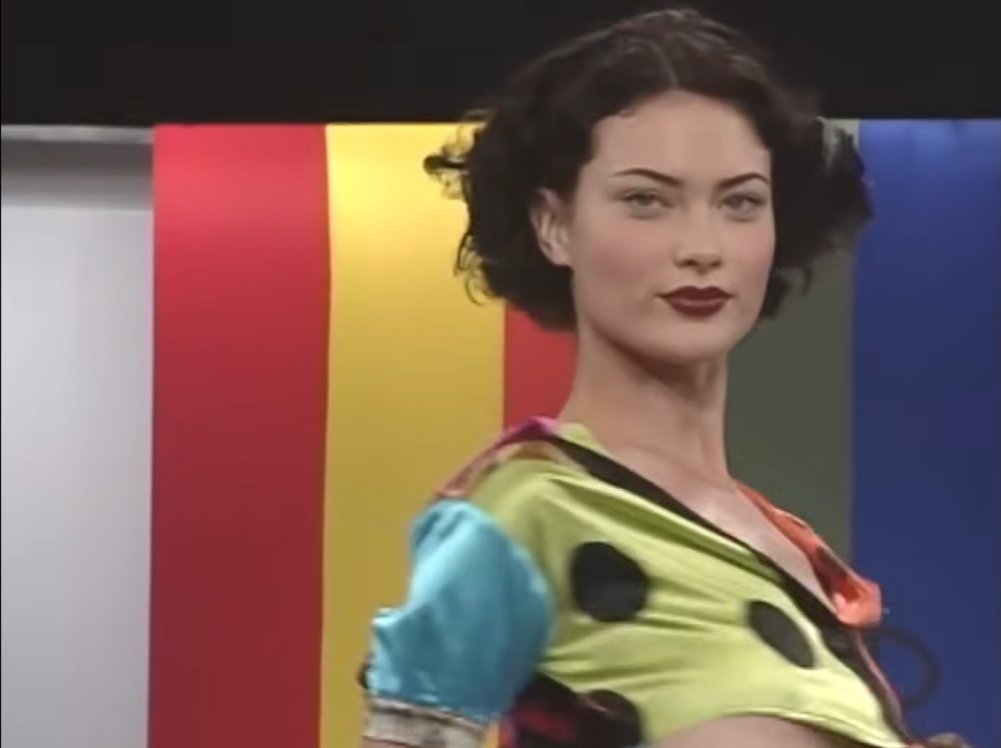
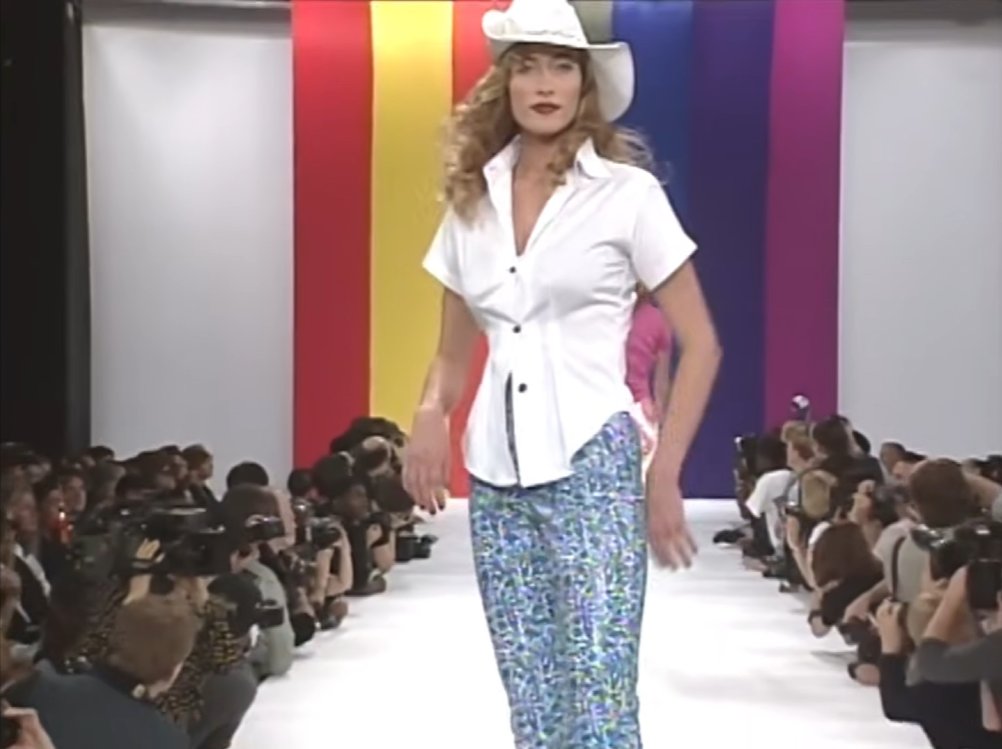
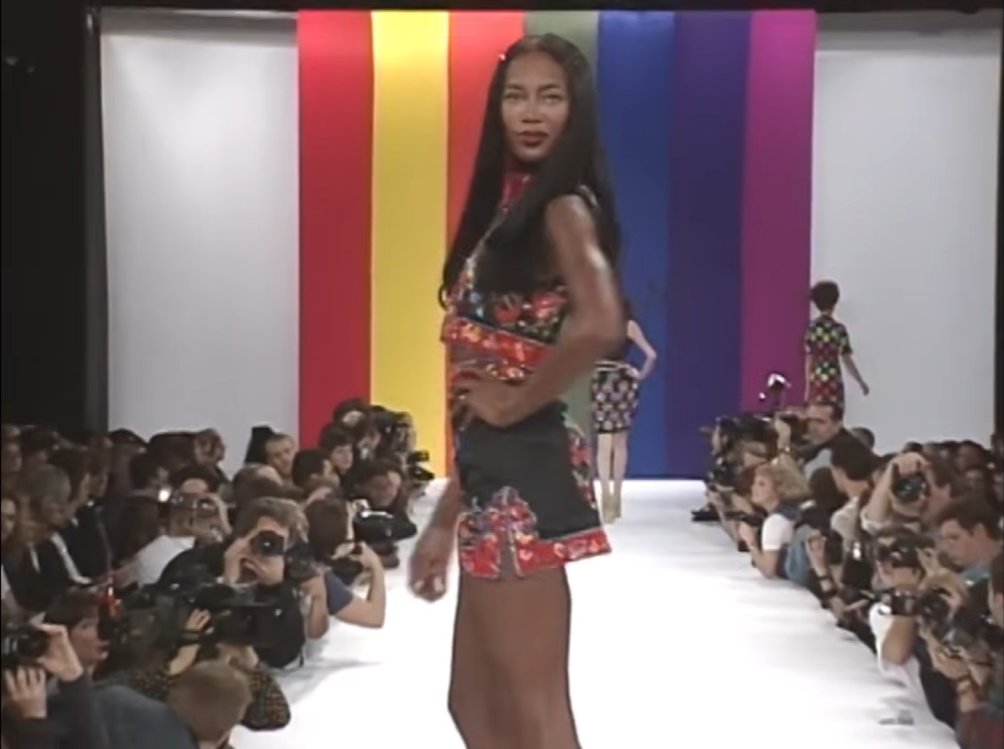
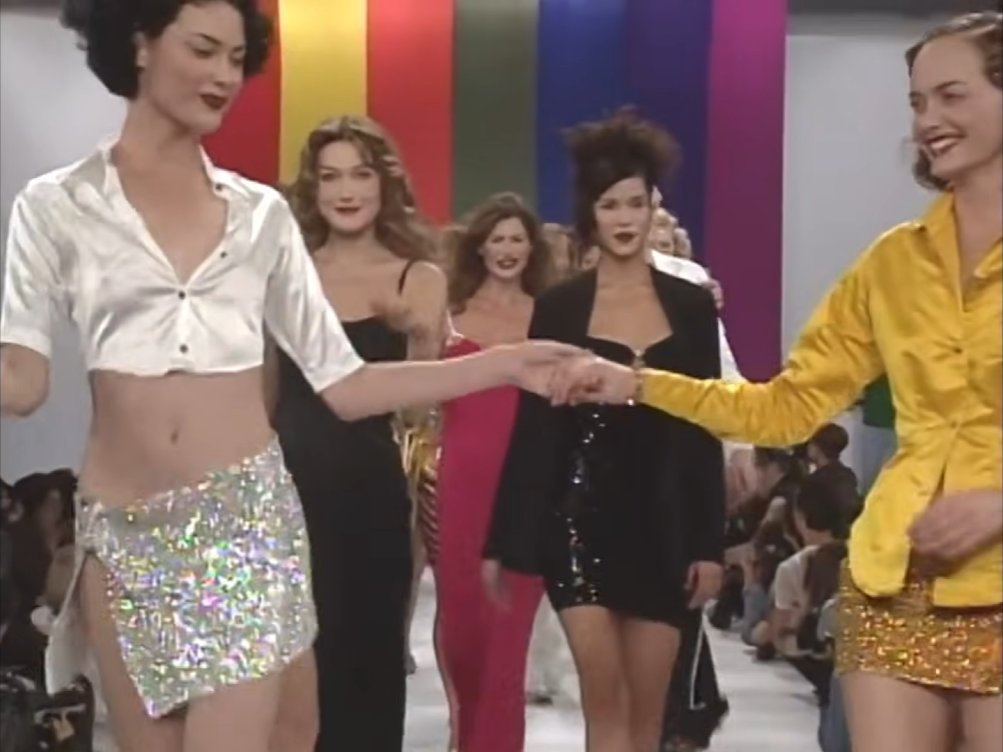
House: Todd Oldham · Designer: Todd Oldham · Season: Spring/Summer 1995
Todd Oldham's Spring/Summer 1995 show was '90s New York maximalism at full volume. Oldham was a self-taught designer from Corpus Christi, Texas, who refused to use animal products and was always testing the limits of textile craft, showed off his skills with this tremendous collection. Carla Bruni wore a white dress with stripes hand-painted on the inside so they bled softly through the fabric. Tyra Banks wore a dress made with sublimation printing, which uses heat and pressure to set a pattern. Shalom Harlow closed the show in a transparent skirt covered entirely in prong-set Swarovski crystals. The finale produced one of the most replayed moments of the supermodel era: Harlow sped up and overtook Amber Valletta on the runway, then the two walked side by side and turned to the crowd in unison. Plenty of viewers read it as a rivalry, but the two came back out at the end holding hands, and Harlow later explained she was simply feeling the music and the energy of the crowd.
When I came across this show in my YouTube recommendations, I immediately thought that the looks here reminded me of Parker Posey in Party Girl. As it turns out, the costume designer of the movie, Michael Clancy, dressed Posey in Todd Oldham for the movie! The flamboyant and bright colors and patterns, the way the models bounce to the '90s house music, it really does remind you of old New York (or what others recall of it, I wasn't born yet). I imagine young women stomping the dirty streets of the towns during the day, and gliding over the spit-soaked concrete at night as they leave the club doors behind, disco lights slogging through the fog. This show makes me want to go out and meet one (or a few, who's counting?) of these wonderful ladies. This show screams social life, something many people are dying for. Hopefully life can support this kind of vitality once more, but we must be ready to temper the pavement with twice the fervor of those who came before us, so that we never lose sight of what they had, and never dare to take it for granted.
Sources: Dazed · W Magazine · The Happy Isles · Vogue Hong Kong · Wexarts · McNay Art Museum
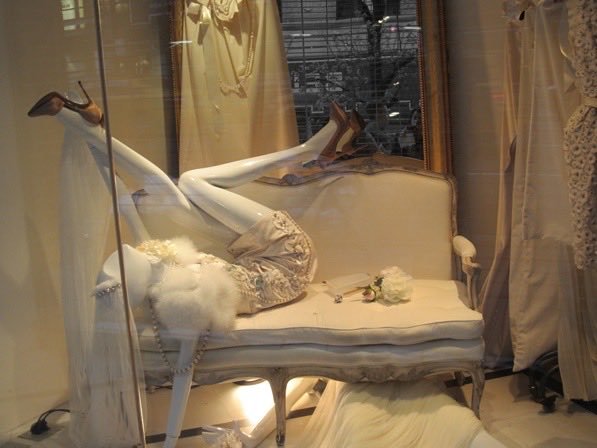
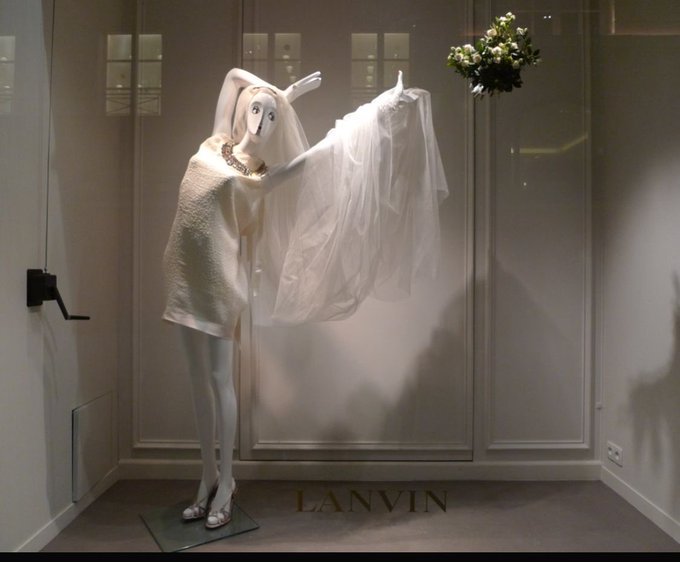
Answer: Lanvin
During Alber Elbaz's years as creative director of Lanvin, from 2001 to 2015, the house's flagship at 22 Rue du Faubourg Saint-Honoré in Paris became famous for its window displays. The scenes changed roughly every month and were staged dramaturgically, with mannequins writhing on divans, hanging from hula hoops or sprawled between hay bales. They were surrounded by props like artworks, vintage trucks, paint splashes, gilt mirrors and musical instruments made from crushed tin cans. One week a pair of mother-and-daughter mannequins with bubblegum-pink skin stood in matching big-shouldered dresses. Another time, a cloud of butterflies filled the glass to echo a butterfly-print collection. "When I do windows, I don't start with a red dress or a white coat," Elbaz wrote. "I begin with a dream, with a story, and with a sketch." He even put miniature mannequins in his own designs in the windows, which inspired a line of collectible hand-painted "Miss Lanvin" dolls. The windows were so loved that in 2014 Rizzoli published Lanvin: I Love You, a book of nearly 200 of these scenes alongside Elbaz's hand-drawn concept sketches. The address itself carries history: Jeanne Lanvin, a milliner who started her business in the 1880s, moved her house to 22 Rue du Faubourg Saint-Honoré in 1893. Its famous logo of a mother and daughter came from a 1907 photo of Jeanne and her daughter Marguerite at a costume ball. Elbaz left Lanvin in 2015, launched his own label, AZ Factory, in 2021, and unfortunately died of Covid-19 that April at age 59.
Sources: Instagram (more images here) · WWD · WWD · Design Scene · Dezeen · Musée des Arts Décoratifs
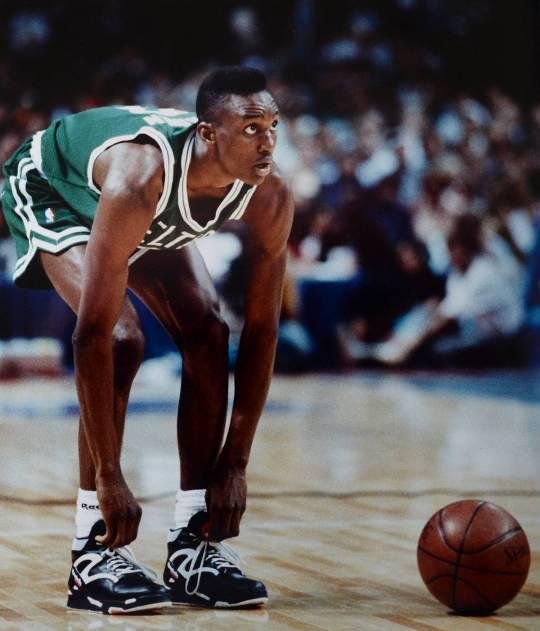
Answer: Dee Brown
On February 9, 1991, at NBA All-Star Weekend in Charlotte, Boston Celtics rookie Dee Brown won the Slam Dunk Contest with a moment that turned into one of sneaker marketing's biggest accidental wins. He was a late addition to an eight-man field that also included Shawn Kemp, hometown Hornets Rex Chapman and Kendall Gill, Kenny Smith, Blue Edwards, Otis Smith and Kenny Williams. Before his first dunk, Brown knelt down and pumped air into his black Reebok Pumps, sneakers built around inflatable air bladders that Reebok had launched in November 1989. Then he threw down a backward two-handed jam. The crowd loved it. In the finals against Kemp, who was dunking with raw power, Brown improvised a no-look slam, covering his eyes with his forearm as he went up. It sealed the title so convincingly that he didn't need his final dunk. The pumping gesture was Brown's own spontaneous idea, not a planned ad, but a TNT broadcaster estimated it was worth about a million dollars in free advertising for Reebok, which quickly built national campaigns around him and gave him his own Pump model. A 6-foot-1 guard out of Jacksonville University who'd been overshadowed by Larry Bird and the Celtics' veterans, Brown became a household name overnight, made the NBA's All-Rookie team that season and went on to play 12 seasons in the league.
His daughter Lexi Brown is also really pretty.

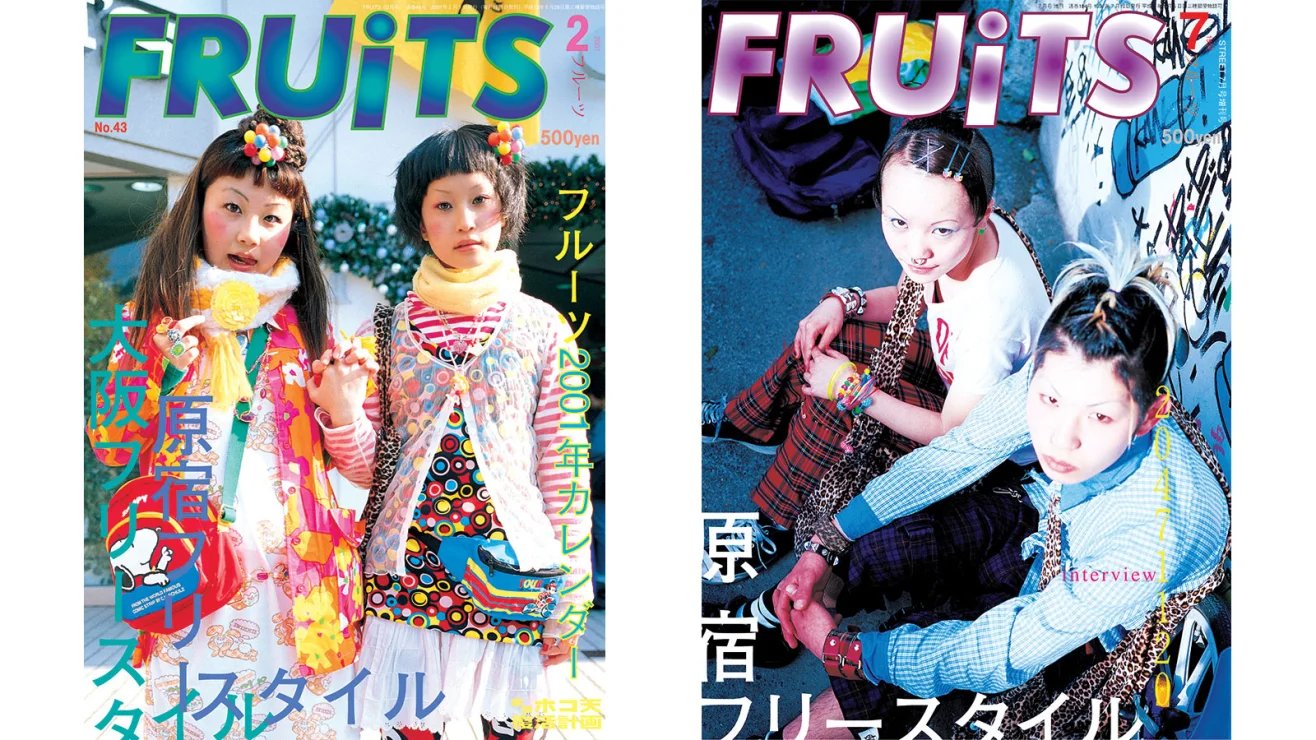
Answer: cool kids
Before FRUiTS, Shoichi Aoki founded STREET in 1985, a magazine of candid street-style photos from Paris, London, New York, Antwerp, Berlin, and beyond. In 1997 he turned his lens on one neighborhood: Harajuku, Tokyo. FRUiTS documented the area's teenagers as they mixed labels like Comme des Garçons, Vivienne Westwood and Hysteric Glamour with tie-dye, crochet, kimonos and wooden geta sandals, and it became the defining record of subcultures like decora, gyaru-adjacent ganguro and Harajuku punk. Aoki saw style as a kind of skill, and for two decades his magazine was a bible for designers and fashion fans around the world. The final issue came out at the end of 2016, and when Aoki announced the closure in early 2017, his reason became famous: "there are no more cool kids to photograph." He blamed the spread of Western fast fashion and the shift to social media, which had changed how young people dressed and where style got seen. The story didn't fully end there: the STREET and FRUiTS archives were later digitized for fans to download, and Aoki has since talked about reviving FRUiTS, inspired by a new wave of designers drawing on Harajuku's legacy.
Sources: CNN · Ambush · Dazed · Sabukaru · No Kill Mag · Remy Solomon
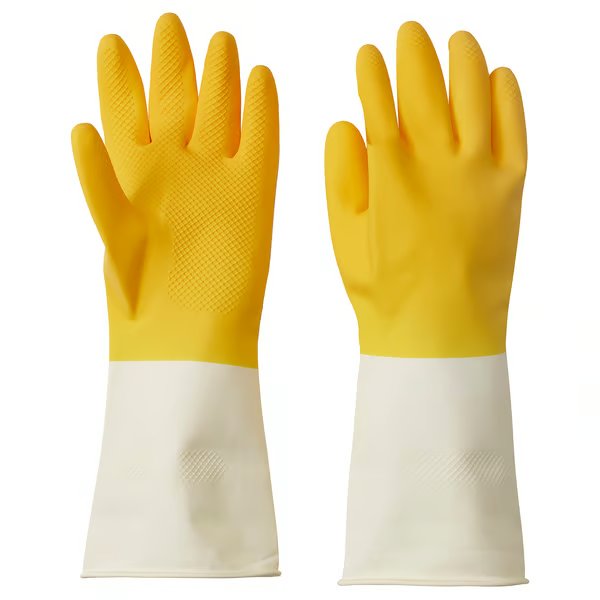
IKEA RINNIG Cleaning gloves, bright yellow/off-white, M